



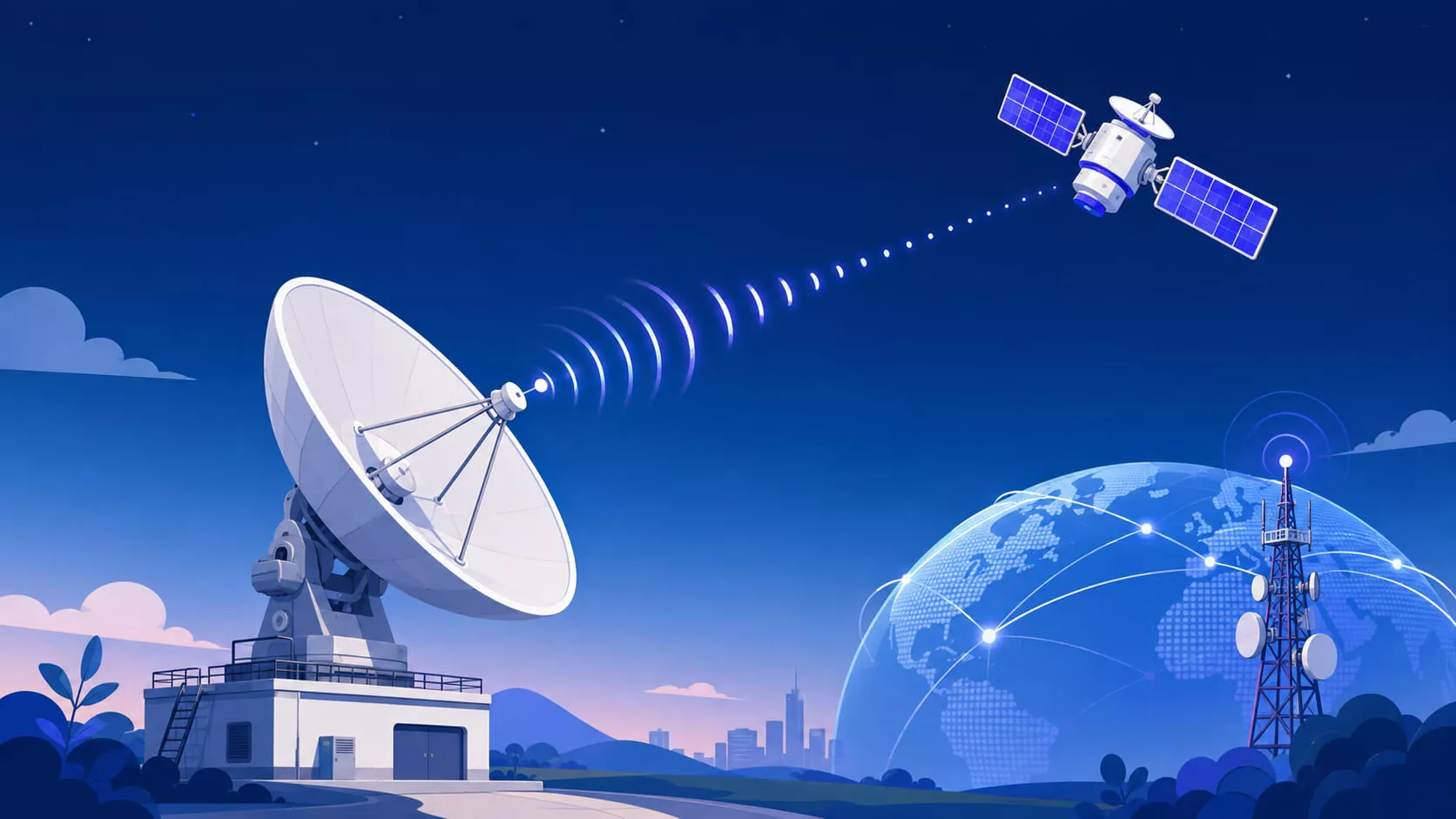
Telecom operators expanding into remote regions, disaster-prone areas, or markets without reliable terrestrial infrastructure face a recurring problem: fiber and cellular towers simply can't reach everywhere, and building them out is often slower and more expensive than the business case allows. Satellite earth stations solve this by giving operators a way to backhaul traffic, extend network coverage, and keep services running in places ground-based infrastructure can't economically reach.
But choosing the right earth station isn't as simple as picking a dish off a spec sheet. Frequency band, antenna size, and mount type all interact with your specific network footprint — the climate you're deploying into, the traffic volume you need to carry, and whether your roadmap includes newer LEO constellations alongside traditional GEO links. Get these decisions right, and you get a gateway station that quietly does its job for the next 15–20 years. Get them wrong, and you're either overpaying for capacity you'll never use, or rebuilding infrastructure years ahead of schedule.
This guide breaks down exactly what telecom operators and network planners need to evaluate before committing to a satellite earth station — from frequency band selection through supplier vetting — so you can make a sourcing decision with confidence rather than guesswork.
Table of Contents
1. Why This Decision Matters More Than It Looks
For a telecom operator, a satellite earth station isn't a one-off purchase — it's infrastructure you'll be running for 15 to 20 years, often in locations that are expensive to revisit once installed. Get the antenna size, frequency band, or mount type wrong, and you're either overpaying for capacity you don't need, or scrambling to upgrade a gateway station three years into a network expansion plan. This guide walks through the decisions that actually matter, in the order procurement teams and network planners typically need to make them.
2. C-Band vs Ku-Band: Picking the Right Frequency
This is usually the first fork in the road, and it shapes almost every other decision after it.
C-Band operates at lower frequencies (roughly 4–8 GHz) and is prized for one thing above all: resistance to rain fade. If your network footprint includes tropical or high-rainfall regions — Southeast Asia, Central Africa, parts of Latin America — C-Band keeps signal quality stable when a Ku-Band link would be struggling through a storm. The trade-off is size: C-Band requires a physically larger antenna to achieve the same gain, and available bandwidth is generally tighter and more expensive per MHz in many regions.
Ku-Band (roughly 12–18 GHz) allows smaller antennas for the same performance, more available spectrum in most satellite fleets, and lower equipment costs. The trade-off is rain fade — heavy precipitation can degrade or briefly interrupt the link. For temperate climates, or for backhaul routes where a brief rain-related outage is tolerable, Ku-Band is usually the more cost-effective choice.
Quick rule of thumb: if your deployment region has a serious rainy season, lean C-Band. If your priority is minimizing footprint and cost, and rainfall isn't extreme, Ku-Band is usually the better fit. Some operators run both — C-Band for core backbone links, Ku-Band for lower-priority regional connections — to balance reliability against budget.
3. Antenna Size: Matching Dish Diameter to Your Traffic Needs
Antenna diameter directly determines gain — bigger dish, stronger signal, more capacity, better resistance to interference. But bigger also means higher cost, larger footprint, longer installation time, and stronger structural/wind-load requirements. Here's roughly how operators typically map diameter to use case:
| Diameter Range | Typical Use Case |
|---|---|
| 1.8m – 2.4m | VSAT terminals, remote site connectivity, small-scale enterprise or rural broadband nodes — for example, a 1.8m Fixed Earth Station Satellite Dish Antenna |
| 3m – 4.5m | Regional gateway stations, medium-capacity backhaul links, mobile network base station connectivity — this range typically covers designs like a 4.5m C/Ku Band Limited Motion Satellite Communication Antenna |
| 6m – 9m | Primary telecom gateway stations, TV uplink, higher-throughput backhaul between core network nodes — larger builds in this range are often Cassegrain-type designs such as a 9m Cassegrain Satellite Communication Antenna |
| 11m – 13m | Major hub/gateway stations, national or carrier-grade backbone links, high-capacity multi-transponder operations — at this scale, operators typically look at large-aperture builds like a 13m Cassegrain Satellite Communication Antenna |
The right number isn't just about "how much data" — it's about your link budget as a whole (satellite EIRP, distance, frequency, required availability). This is usually where working with a supplier who can run an actual link budget calculation for your specific route pays off, rather than sizing an antenna off a rule of thumb alone.
4. Fixed vs Mobile/Trackable Stations: Which Fits Your Network?
Fixed stations are built for permanent gateway sites — they point at one geostationary satellite and stay there. Lower mechanical complexity, lower long-term maintenance, and generally lower cost for a given size. This is the standard choice for a stable, planned gateway location, and a mid-size option like a 3.0m Earth Station Satellite Antenna is a common fit for smaller regional sites.
Mobile or trackable stations add motorized tracking systems that can follow a satellite's position, or be repositioned between sites. This matters in two scenarios that are becoming more common for telecom operators: rapid deployment for disaster recovery or temporary network extension, and tracking non-geostationary (LEO/MEO) satellites, which move relative to the ground and require continuous repositioning rather than a fixed point. Larger trackable builds such as a 6.2m Turntable Earth Station Satellite Communication Antenna or a fully motorized option like the 3.7m Motorized Full Motion Earth Station Antenna are typically used where continuous repositioning is required.
Why this is becoming a bigger question: as more operators add LEO constellation capacity alongside traditional GEO links, ground infrastructure needs to handle frequent handovers between fast-moving satellites — something a fixed-mount antenna simply can't do. If LEO integration is anywhere on your roadmap, it's worth planning for trackable capability now rather than retrofitting later.
5. Technical Specs Every Procurement Team Should Check
Beyond band and size, a handful of specs determine whether a station will actually perform in your network — these are worth putting directly into your RFQ:
- Gain (dBi) — directly tied to link budget performance; confirm it's measured at your intended operating frequency, not just a general figure
- G/T ratio (figure of merit) — how well the station receives weak signals relative to its own noise; critical for downlink quality
- Pointing accuracy — especially important for larger dishes and any trackable/mobile system, since even small pointing errors cause meaningful signal loss at higher frequencies
- Cross-polarization isolation — affects how well the antenna avoids interference from adjacent satellites or the opposite polarization
- Wind survival rating — both operational wind speed (station still functions) and survival wind speed (station survives without damage, even if temporarily non-operational)
- Feed system compatibility — confirm the feed and LNB/BUC configuration matches your intended transponder plan, especially if you're integrating with existing RF chains
6. Site Conditions and Environmental Ratings
A spec sheet that looks great in a datasheet can underperform badly on-site if the environmental rating doesn't match reality. A few things worth confirming before finalizing a purchase:
- Operating temperature range — matters a lot for desert or extreme-cold deployment sites
- Humidity and coastal/salt-spray resistance — relevant for any site near the coast, not just maritime applications
- Seismic rating — worth checking for sites in earthquake-prone regions, particularly for larger, taller structures
- IP rating on exposed electronics — feed assemblies and outdoor units should be rated for the actual weather conditions of the install site, not a generic baseline
7. What to Look for in a Supplier
The antenna itself is only part of the decision — who you buy it from affects lead time, long-term support, and how smoothly your network expansion actually goes. Worth checking before you commit:
- Can they run a link budget calculation specific to your satellite and location, rather than just quoting off a catalog?
- Do they offer both C-Band and Ku-Band, and fixed and trackable mounts, so you're not locked into one architecture as your network evolves?
- What's the actual lead time for your required diameter, and does it change for customized configurations?
- Do they provide installation support, commissioning, and pointing calibration, or just ship the hardware?
- What's their track record with telecom-grade deployments specifically, versus broadcast or government-only projects?
- Is spare parts availability and after-sales support realistic for your deployment region, especially for remote sites?
8. Total Cost of Ownership, Not Just Purchase Price
The upfront antenna price is often a smaller piece of the puzzle than it looks. Worth factoring into the real comparison between options:
- Installation and civil works — larger dishes need proper foundations, and remote sites add logistics cost
- Maintenance requirements — motorized tracking systems generally need more upkeep than fixed mounts
- Power consumption — relevant for off-grid or solar-powered remote sites
- Expected lifespan and warranty terms — a cheaper unit with a shorter realistic service life may cost more over a 15-year horizon than a pricier, better-built one
- Spectrum/bandwidth cost differences between C-Band and Ku-Band in your specific operating region — this can outweigh the hardware price difference over time
9. A Quick Pre-Purchase Checklist
- Confirmed frequency band based on climate and rain fade tolerance
- Antenna diameter sized against an actual link budget, not a rough estimate
- Decided fixed vs trackable, with LEO integration plans considered
- Verified gain, G/T, pointing accuracy, and wind ratings against your operating conditions
- Confirmed environmental rating matches your actual deployment site
- Checked supplier's ability to support installation, commissioning, and after-sales
- Compared total cost of ownership, not just sticker price
10. Frequently Asked Questions
Can one earth station support both C-Band and Ku-Band?
Dual-band feed systems exist and allow a single antenna to operate across both bands, though they typically involve a more complex feed assembly and a moderate cost premium compared to a single-band system. For operators planning to use both bands long-term, it's worth evaluating against the cost of simply deploying two dedicated single-band stations.
How long does it typically take to deploy a new gateway station?
This varies widely by antenna size and site conditions, but for a mid-size fixed station, timelines commonly range from a few weeks to a few months once equipment arrives on-site, factoring in foundation work, installation, and pointing/commissioning. Larger stations (9m+) and remote or difficult-access sites generally take longer.
Do smaller antennas mean lower capacity, or just lower gain?
Smaller antennas have lower gain, which reduces the achievable data rate for a given satellite and link budget — but capacity ultimately depends on the full link budget, not diameter alone. A well-engineered smaller antenna paired with the right satellite and power settings can still deliver solid performance for the right use case, such as VSAT or remote site backhaul.
Is a trackable antenna necessary if we're only using GEO satellites?
Not necessarily. A fixed-mount antenna is generally sufficient and more cost-effective for a stable GEO satellite connection. Trackable systems become important primarily for LEO/MEO satellite tracking, or for scenarios requiring mobility, such as disaster recovery or temporary deployments.
What's the biggest mistake telecom operators make when sourcing earth stations?
Sizing the antenna off a general rule of thumb rather than an actual link budget calculation for the specific satellite, orbital position, and route. This often leads to either underperforming links in poor weather, or overspending on capacity the network doesn't actually need.