



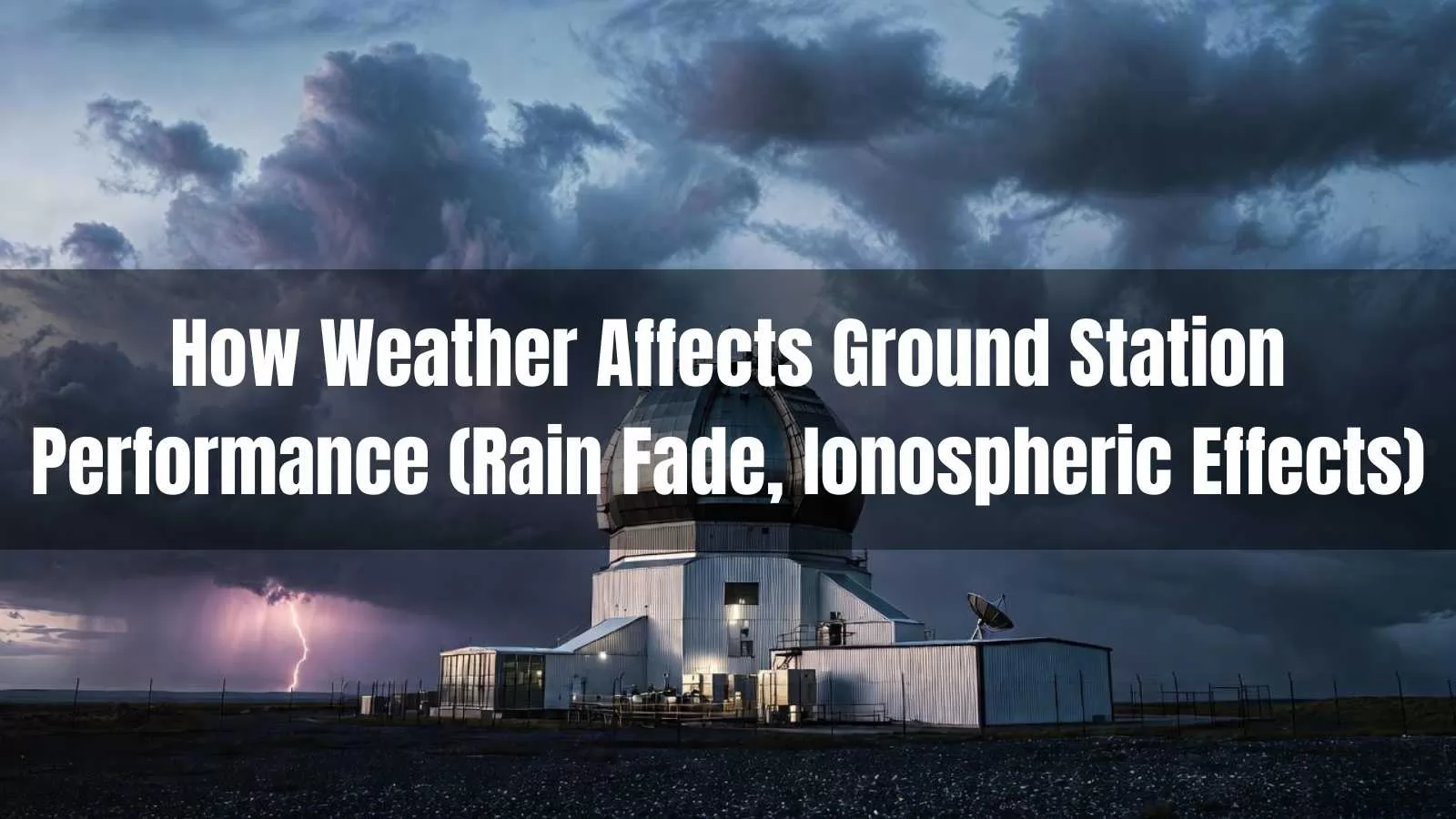
In the ecosystem of satellite communications (Satcom), the space between the satellite and the ground station is far from a vacuum. As electromagnetic waves traverse the Earth's atmosphere, they encounter physical phenomena that can degrade, scatter, or even block signals. For operators using high-frequency bands like Ku, Ka, and the emerging Q/V bands, weather is the primary variable determining Link Availability.
This guide analyzes the technical logic behind atmospheric interference and provides industrial-grade strategies to maintain robust connectivity in adverse conditions.
1. Rain Fade: The Primary Threat to High-Frequency Links
The Physics of Attenuation (Why & How)
Rain fade occurs when the wavelength of the satellite signal (particularly above 10 GHz) is comparable to the size of raindrops. This leads to absorption (where signal energy is converted to heat) and scattering (where the signal is reflected away from the receiving antenna).
- Frequency Sensitivity: Higher frequencies have shorter wavelengths, making them more susceptible. Ka-band (30 GHz) is significantly more affected than C-band (4-8 GHz).
- Depolarization: Falling raindrops are non-spherical (oblate). This shape can change the signal's polarization state, leading to Cross-Polarization Interference (XPI).
Mitigation Strategies
- Adaptive Coding and Modulation (ACM): The system monitors the Signal-to-Noise Ratio (SNR) in real-time. During heavy rain, it automatically switches to a more robust, lower-order modulation (e.g., from 32APSK to QPSK) to maintain the link at the cost of bandwidth.
- Uplink Power Control (UPC): The ground station increases its transmission power automatically to overcome the decibel loss caused by local precipitation.
- Site Diversity: Deploying two ground stations 10-20 km apart. Since intense rain cells are usually localized, if one station is "blinded," the other likely has a clear line of sight.
2. Ionospheric Effects: Challenges for Low-Band and Polar Regions
Key Phenomena
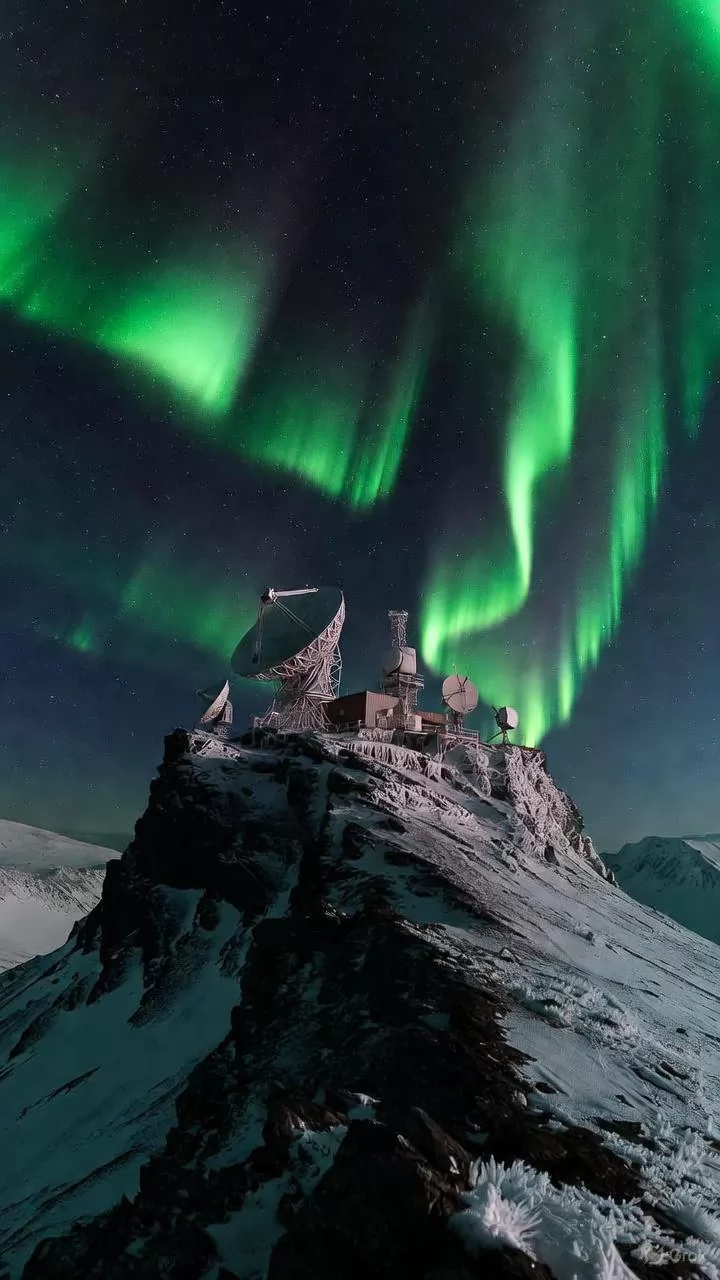
The Ionosphere—a region of the upper atmosphere ionized by solar radiation—primarily impacts L, S, and X bands, though its effect on polar LEO (Low Earth Orbit) paths is significant for all bands.
- Scintillation: Rapid fluctuations in amplitude and phase caused by irregularities in electron density. It is similar to the "twinkling" of stars.
- Faraday Rotation: The rotation of the polarization plane as the signal passes through the Earth's magnetic field in the ionosphere.
Technical Selection Criteria
Systems operating in equatorial or polar regions must utilize advanced Phase-Locked Loop (PLL) algorithms to stay synchronized during scintillation events. Phased array terminals, such as those developed by NewStar, can electronically compensate for phase shifts faster than traditional mechanical systems.
3. Beyond Rain: Other Atmospheric Factors
Gaseous Absorption
Even on clear days, oxygen and water vapor molecules absorb signal energy. There are specific "absorption peaks" at 22.2 GHz (water vapor) and 60 GHz (oxygen). Link budgets must account for these fixed losses during the design phase.
Snow and Ice Accumulation
While dry snow has a lower dielectric constant than rain, accumulation on the antenna reflector distorts its parabolic shape, causing massive gain loss. Radomes equipped with hydrophobic coatings and automated heating systems are essential for ground stations in high-latitude regions.
4. Weather Resilience Matrix
| Factor | Worst Affected Bands | Hardware Mitigation | Operational Strategy |
|---|---|---|---|
| Heavy Rain | Ka, Q/V Band | High-Power BUC, High-Gain Antenna | ACM & Site Diversity |
| Sand/Dust | Ku, Ka Band | IP66+ Sealing, Abrasion Resistance | Frequent Feed-horn Cleaning |
| Extreme Cold/Snow | All Bands | De-icing Radomes, Heated BUC | Structural Load Monitoring |
| Solar Noise | All Bands | Narrowband Filters | Sun Outage Prediction |
5. FAQ: Real-World Scenarios
Q: If I operate in a desert, can I ignore rain fade?
A: While rain is rare, deserts often experience sandstorms. Dust particles, especially when dry, can cause electrostatic interference and signal scattering. High-IP-rated equipment with precision beam tracking is still required.
Q: Why are LEO satellites more sensitive to weather?
A: LEO satellites move at over 7.5 km/s. As they pass through a rain cell, the attenuation level changes violently within seconds. This requires the ground station's Automatic Gain Control (AGC) and beam-tracking algorithms to have extremely fast response times.
Q: Does a Radome add signal loss?
A: A high-quality radome causes negligible loss (<0.2dB) in clear weather. However, in rain, it prevents a "water film" from forming on the antenna surface, which actually reduces total attenuation significantly compared to an unprotected dish.
Conclusion: Building for Climate Resilience
Weather is an objective reality of Satcom, but it is no longer an insurmountable barrier. By utilizing NewStar’s advanced phased array terminals—which feature high-density RF design and integrated adaptive link algorithms—operators can achieve robust connectivity even in challenging environments.
About NewStar: We provide all-weather satellite ground segment solutions. Our innovative Electronically Steered Array (ESA) technology ensures that your mission stays connected, regardless of the climate.
Get a Professional Link Budget Assessment from NewStar →